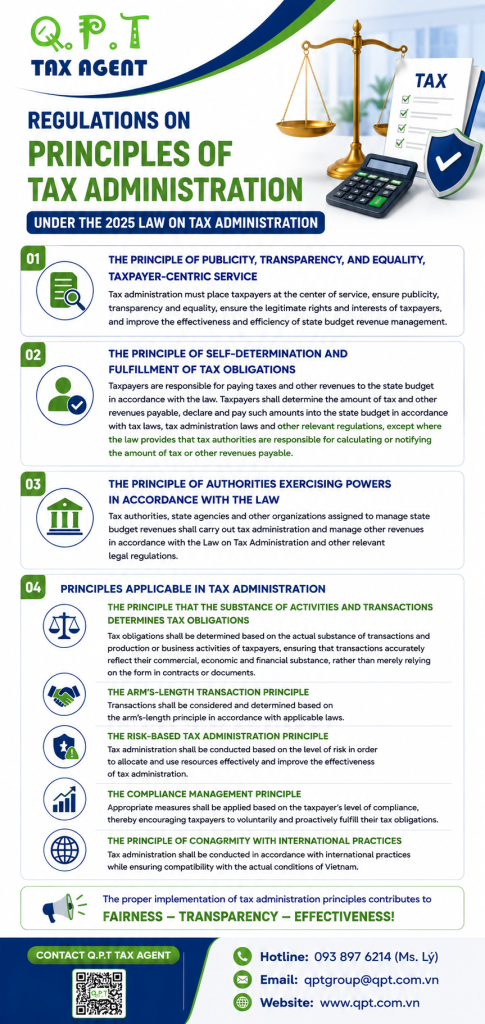


How to Declare Registration Fee from July 1, 2026 under Circular 89/2026/TT-BTC?
Pursuant to Clause 2, Article 26 of Circular 89/2026/TT-BTC, the declaration of registration fee (stamp duty) from July 1, 2026 is carried out as follows:
- For assets subject to registration of ownership or use rights: The taxpayer must submit the registration fee declaration dossier within the same deadline as the application for registration of ownership or use rights of the asset at the competent state authority. This also applies to procedures carried out under the interconnected one-stop mechanism or dossiers submitted directly to the tax authority.
- For houses and land: The registration fee declaration dossier must comply with Point 11 of Appendix I issued together with Circular 89/2026/TT-BTC.
- For fishing vessels, inland waterway transport vessels and seagoing ships in cases where the original documents are missing or the vessels are newly built in Vietnam: The registration fee declaration dossier must comply with Point 11 of Appendix I issued together with Circular 89/2026/TT-BTC.
- For other assets: The registration fee declaration dossier must comply with the regulations on registration fees and Point 11 of Appendix I of Circular 89/2026/TT-BTC. This does not include fishing vessels, inland waterway transport vessels and seagoing ships with missing original documents or newly built in Vietnam as mentioned above.
- For cases specified in Clause 10, Article 11 of Decree 252/2026/ND-CP: The taxpayer is not required to submit a registration fee declaration dossier.
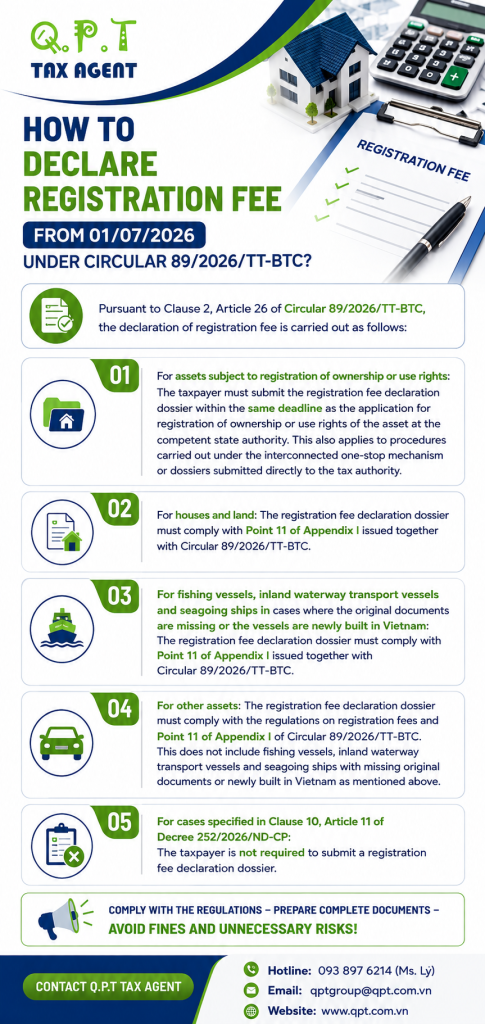
What are the regulations on the dossier for registration fee exemption?
Pursuant to Article 74 of Circular 89/2026/TT-BTC, taxpayers eligible for registration fee exemption must make the declaration in accordance with Clause 2, Article 26 of this Circular, and at the same time submit copies of documents proving that the asset or asset owner is eligible for registration fee exemption as a basis for processing the exemption. Specifically:
- Land allocated, leased, or recognized by the State for agricultural production, forestry, aquaculture, or salt production purposes: A confirmation from the Land Registration Office on the “Information transfer form/document determining financial obligations” stating that the land is eligible for the issuance of a Certificate of Land Use Rights under the form of land allocation, land lease, or recognition of land use rights by the State.
- Land used for community purposes by religious organizations or belief establishments: Documents proving that the religious establishment has been recognized or permitted to operate by the State.
- Houses, land and special-purpose assets, specialized assets, and assets serving national defense and security purposes: A decision issued by a competent authority approving the allocation, procurement, or investment in such assets, or a confirmation from a competent authority under the public security or national defense sector that the houses, land, and assets of the unit are specialized assets serving national defense and security purposes.
-
Compensated or resettled houses and land: The dossier includes:
- The decision on recovery of the old house or land and the decision on allocation of the new house or land issued by the competent authority;
- The Certificate of Land Use Rights, ownership of houses and other assets attached to land of the person whose house or land was recovered, provided that the Certificate does not record any outstanding financial obligations.
In cases where the registration fee obligation has already been fulfilled but the Certificate has not yet been issued or has been lost, the taxpayer must provide proof of payment of the registration fee, a confirmation from the authority managing the house and land records, or a decision on registration fee exemption issued by a competent authority.
In cases where compensation or support is received in cash, the dossier must include a lawful invoice or contract for transfer of land use rights or house sale, together with documents evidencing receipt of compensation or support payments made by the authority recovering the house or land.
- Cases of replacement of a Certificate of ownership or use rights of an asset: Documents proving the ownership or use rights of the asset for which the Certificate has been replaced.
- Assets of an enterprise equitized into a joint-stock company: The dossier includes:
- A decision of the competent authority on conversion of the enterprise into a joint-stock company or a decision on restructuring the enterprise;
- A list of assets transferred from the enterprise to the joint-stock company or to the new enterprise under the restructuring decision. In cases of partial equitization, a decision on asset transfer is required. This may be replaced by a summary of the inventory results and the revaluation of the enterprise’s assets, clearly identifying the assets for which registration fee declaration procedures are being carried out.
- Assets for which registration fees have already been paid and which are divided or contributed upon division, separation, consolidation, or merger of an organization: The dossier must include:
- Documents proving that the person whose asset has already been subject to registration fee was a member of the organization, such as the establishment decision, charter, documents evidencing contribution of assets as capital, or documents showing the member’s name in the business registration;
- The decision on dissolution, division, separation, consolidation, or merger and documents on the distribution of assets to capital-contributing members;
- Proof of registration fee payment; or a registration fee declaration bearing confirmation of exemption; or a registration fee payment notice issued by the tax authority for the person transferring the asset. Where applicable, a Certificate of ownership or use rights of the asset bearing the name of the capital-contributing person or dissolved organization may be used;
- A business cooperation contract in the case of capital contribution; or a decision on the distribution or transfer of assets in the form of increasing or decreasing capital, issued by the competent authority, in cases of transfer of assets between member units or within a budgetary unit.
Continuing under Article 74 of Circular 89/2026/TT-BTC, documents proving that the asset or asset owner is eligible for registration fee exemption are required for a number of cases as follows:
- Charity houses, great solidarity houses, and houses provided as humanitarian support: Documents evidencing the transfer of land use rights and house ownership between the donor and the recipient.
- Financially leased assets: The dossier includes:
- A financial leasing agreement signed between the lessor and lessee in accordance with regulations;
- The liquidation minutes of the financial leasing agreement;
- The Certificate of land use rights or ownership of the asset in the name of the financial leasing company.
- Replacement shells, frames, or engine assemblies that must be re-registered during the warranty period: A warranty certificate for the asset and a warehouse release note for the replacement asset, together with a document certifying the recovery of the old asset issued by the seller to the buyer.
- Cases where registration fee exemption is based on a family relationship: The tax authority is responsible for retrieving information from the National Population Database to process the application. If residence information cannot be retrieved, the taxpayer must provide appropriate documents proving the relationship, such as: a certificate of residence information, Marriage Certificate, Birth Certificate, a decision recognizing adoption issued by a competent state authority, or a confirmation of the relationship issued by a competent state authority.
- Cars that have been registered and issued military license plates by the Ministry of National Defense, which are subsequently permitted to be converted into military vehicles for economic purposes due to the equitization or restructuring of state-owned enterprises: The dossier includes:
- A decision of the Chief of the General Staff on placing the asset into military equipment;
- A decision of the competent authority on converting the enterprise into a joint-stock company or a decision on restructuring the state-owned enterprise;
- A list of assets transferred from the enterprise’s military vehicles serving national defense purposes to the joint-stock company/new enterprise, or a summary of the inventory results and revaluation of assets in accordance with regulations.
- Ships, high-speed passenger vessels, and container transport vessels operating in inland waterway transportation: Eligibility for registration fee exemption is determined based on the Certificate of Technical Safety and Environmental Protection for Inland Waterway Vessels issued by the Vietnam Register. Specifically:
- High-speed passenger vessels: The “Purpose” section must state “passenger vessel”; and the certificate must show the vessel class designation VRH HSC, VRM HSC, or the “Operating Capability” section must indicate a vessel speed of 30 km/h or more.
- Container transport vessels: The “Purpose” section must state “container transport.”
- Other cases eligible for registration fee exemption under the law on registration fees: The taxpayer must provide copies of documents proving that the asset or asset owner is eligible for registration fee exemption, depending on the specific case.
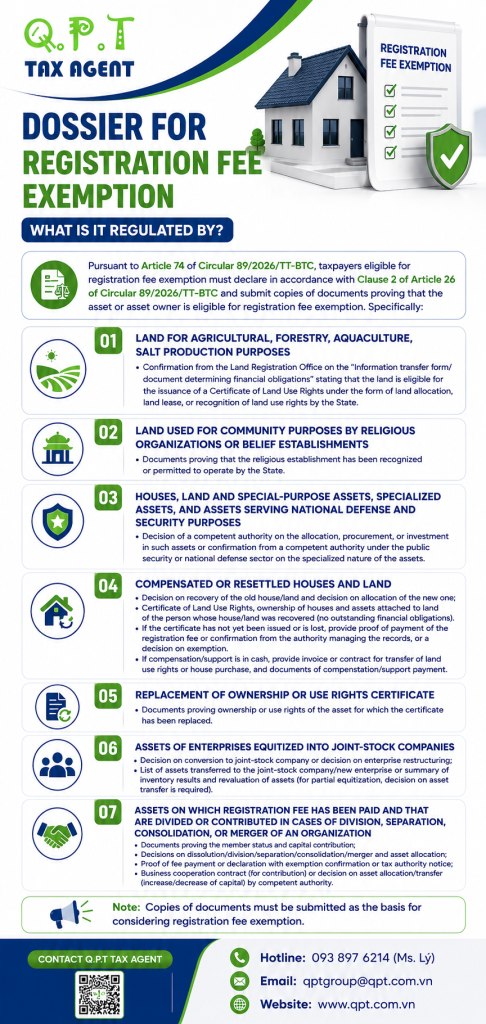

What are the regulations on tax administration principles?
Pursuant to Article 6 of the 2025 Law on Tax Administration, the principles of tax administration are specifically prescribed as follows:
- Ensuring publicity, transparency and equality: Tax administration must place taxpayers at the center of service, ensure the legitimate rights and interests of taxpayers, and improve the effectiveness and efficiency of state budget revenue management.
- Taxpayers shall determine and fulfill their tax obligations: Taxpayers are responsible for paying taxes and other revenues payable to the state budget in accordance with the law. Taxpayers shall determine the amount of tax and other revenues payable, make tax declarations, and pay such amounts into the state budget in accordance with tax laws, tax administration laws and other relevant legal regulations, except where the law provides that tax authorities are responsible for calculating or notifying the amount of tax or other revenues payable.
- Tax authorities shall exercise their authority in accordance with the law: Tax authorities, state agencies and other organizations assigned to manage state budget revenues shall carry out tax administration and manage other revenues payable to the state budget in accordance with the Law on Tax Administration and other relevant legal regulations.
Principles Applicable to Tax Administration
In addition to the general principles above, tax administration shall also be carried out based on the following principles:
- The principle that the substance of activities and transactions determines tax obligations: Tax obligations shall be determined based on the actual substance of the transactions and production or business activities of taxpayers, ensuring that transactions accurately reflect their commercial, economic and financial substance, rather than merely relying on the form presented in contracts or documents between taxpayers and related parties.
- The arm’s-length transaction principle: Transactions shall be considered and determined based on the arm’s-length principle in accordance with applicable laws.
- The risk-based tax administration principle: Tax administration shall be conducted based on the level of risk in order to allocate and use resources effectively and improve the effectiveness of tax administration.
- The compliance management principle: Appropriate measures shall be applied based on the taxpayer’s level of compliance, thereby encouraging taxpayers to voluntarily and proactively fulfill their tax obligations.
- The principle of conformity with international practices: Tax administration shall be conducted in accordance with international practices while ensuring compatibility with the actual conditions of Vietnam.