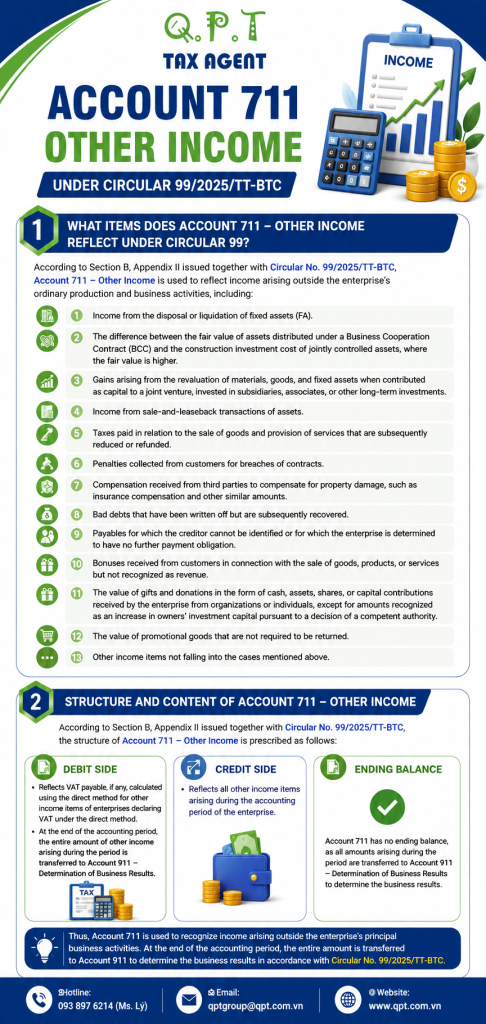


Accounting for Other Income from Sale-and-Leaseback Transactions of Fixed Assets as Finance Leases under Circular 99
According to Section B, Appendix II issued together with Circular No. 99/2025/TT-BTC, the accounting treatment for other income arising from sale-and-leaseback transactions of fixed assets under a finance lease is as follows:
1. The selling price of the fixed asset is higher than its carrying amount
Upon completion of the sale procedures, based on the invoice and relevant supporting documents, the enterprise records:
- Debit 111, 112, 131, etc.: Total payment amount
- Credit 711 – Other Income: Carrying amount of the fixed asset sold and leased back
- Credit 3387 – Deferred Revenue: Difference between the selling price and the carrying amount of the fixed asset
- Credit 3331 – VAT Payable: If applicable
At the same time, the enterprise derecognizes the fixed asset:
- Debit 811 – Other Expenses: Carrying amount of the fixed asset sold and leased back
- Debit 214 – Accumulated Depreciation of Fixed Assets: If applicable
- Credit 211 – Tangible Fixed Assets: Original cost of the fixed asset
2. The selling price of the fixed asset is lower than its carrying amount
Where the selling price is lower than the carrying amount of the fixed asset, upon completion of the sale procedures, based on the invoice and relevant supporting documents, the enterprise records:
- Debit 111, 112, 131, etc.: Total payment amount
- Credit 711 – Other Income: Selling price of the fixed asset
- Credit 3331 – VAT Payable: If applicable
At the same time, the enterprise derecognizes the fixed asset:
- Debit 811 – Other Expenses: Selling price of the fixed asset
- Debit 242 – Deferred Expenses: Difference between the selling price and the carrying amount of the fixed asset
- Debit 214 – Accumulated Depreciation of Fixed Assets: If applicable
- Credit 211 – Tangible Fixed Assets: Original cost of the fixed asset
3. Recognition of the leased asset and lease payments
After completing the sale-and-leaseback transaction, the recognition of finance lease fixed assets, finance lease liabilities, and periodic lease payments shall be carried out in accordance with the guidance on Account 212 – Finance Lease Fixed Assets.
4. Transactions with similar substance
For transactions having a similar substance, such as selling the right to purchase an asset while simultaneously committing to lease the asset back from the customer under a finance lease, the enterprise shall apply the same accounting treatment as for a sale-and-leaseback transaction of a fixed asset under a finance lease.
In summary, depending on whether the selling price is higher or lower than the carrying amount of the fixed asset, the enterprise shall determine the appropriate accounting treatment for other income, deferred revenue, or deferred expenses, respectively.
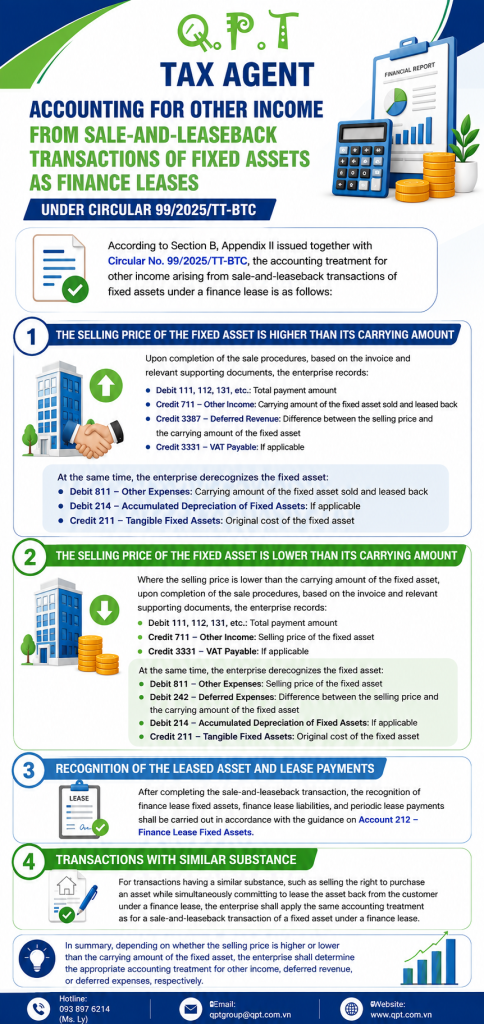
Account 711 – What Other Income Items Are Reflected Under Circular 99?
According to Section B, Appendix II issued together with Circular No. 99/2025/TT-BTC, Account 711 – Other Income is used to reflect income arising outside the enterprise’s ordinary production and business activities, including:
- Income from the disposal or liquidation of fixed assets (FA);
- The difference between the fair value of assets distributed under a Business Cooperation Contract (BCC) and the construction investment cost of jointly controlled assets, where the fair value is higher;
- Gains arising from the revaluation of materials, goods, and fixed assets when contributed as capital to a joint venture, invested in subsidiaries, associates, or other long-term investments;
- Income from sale-and-leaseback transactions of assets;
- Taxes paid in relation to the sale of goods and provision of services that are subsequently reduced or refunded;
- Penalties collected from customers for breaches of contracts;
- Compensation received from third parties to compensate for property damage, such as insurance compensation and other similar amounts;
- Bad debts that have been written off but are subsequently recovered;
- Payables for which the creditor cannot be identified or for which the enterprise is determined to have no further payment obligation;
- Bonuses received from customers in connection with the sale of goods, products, or services but not recognized as revenue;
- The value of gifts and donations in the form of cash, assets, shares, or capital contributions received by the enterprise from organizations or individuals, except for amounts recognized as an increase in owners’ investment capital pursuant to a decision of a competent authority;
- The value of promotional goods that are not required to be returned;
- Other income items not falling into the cases mentioned above.
Structure and Content of Account 711 – Other Income
According to the provisions of Section B, Appendix II issued together with Circular No. 99/2025/TT-BTC, the structure of Account 711 – Other Income is prescribed as follows:
Debit Side
Reflects:
- The VAT payable, if any, calculated using the direct method for other income items of enterprises declaring VAT under the direct method;
- At the end of the accounting period, the entire amount of other income arising during the period is transferred to Account 911 – Determination of Business Results.
Credit Side
Reflects:
- All other income items arising during the accounting period of the enterprise.
Ending Balance
- Account 711 has no ending balance, as all amounts arising during the period are transferred to Account 911 to determine the business results.
Thus, Account 711 is used to recognize income arising outside the enterprise’s principal business activities. At the end of the accounting period, the entire amount is transferred to Account 911 to determine the business results in accordance with Circular No. 99/2025/TT-BTC.