


Guidance on Issuing Invoices for Gifts to Customers and Employees
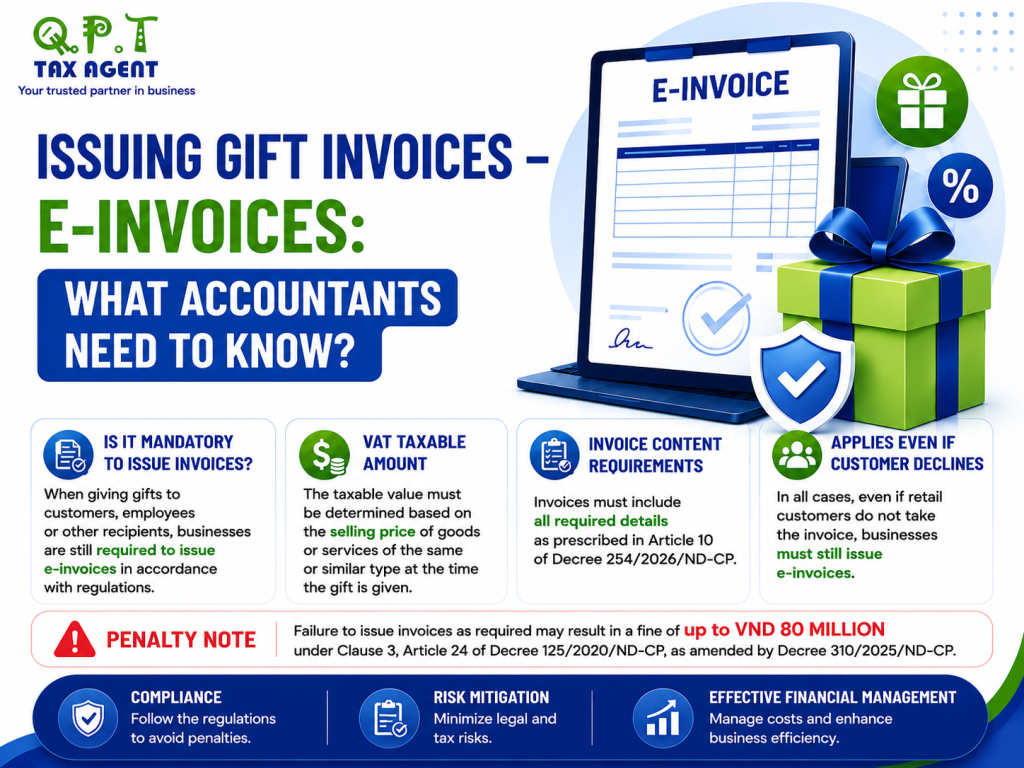
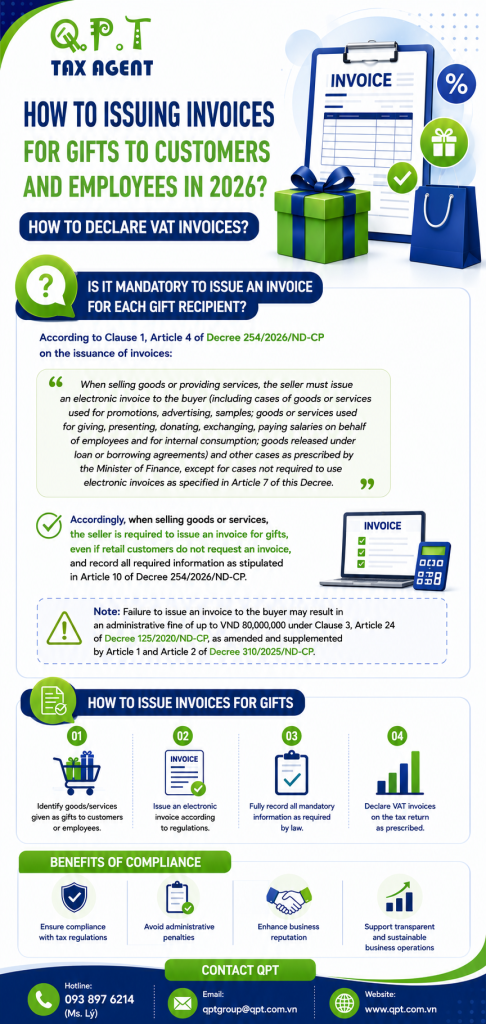
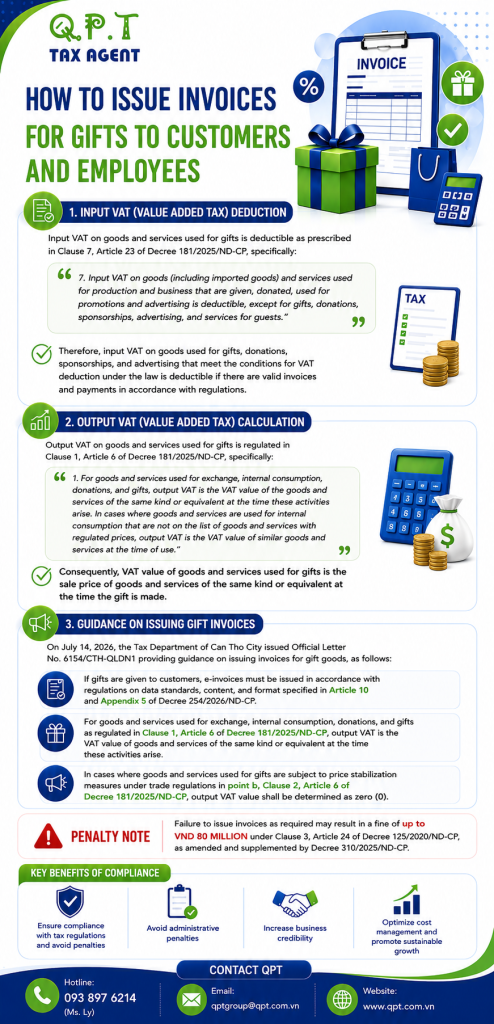
The regulations on input VAT creditability for goods used for giving or donating are stipulated in Clause 7, Article 23 of Decree No. 181/2025/ND-CP. Accordingly, input VAT on goods, including goods purchased from outside or self-manufactured by an enterprise, if used for giving, donating, promotion, or advertising, is eligible for VAT credit in accordance with regulations.
Regarding the VAT taxable price, Clause 1, Article 6 of Decree No. 181/2025/ND-CP stipulates that for goods and services used for exchange, internal consumption, giving, or donation, the VAT taxable price is determined based on the price of goods or services of the same type or equivalent at the time the activity arises.
Accordingly:
- For input VAT on goods used for giving or donation, an enterprise may declare and claim an input VAT credit provided that all requirements regarding valid invoices, supporting documents, and payment in accordance with regulations are satisfied.
- When issuing an invoice for goods given or donated, the VAT taxable price is determined based on the selling price of goods or services of the same type or equivalent at the time the gift is given.
Guidance on Issuing Invoices for Goods Given to Customers
According to Official Letter No. 6154/CTH-QLDN1 dated July 14, 2026, issued by the Can Tho Tax Department, where an enterprise gives goods to customers, it is required to issue an electronic invoice in the standard data format and include all required information in accordance with Article 10 and Point a3, Clause 5 of the Appendix issued together with Decree No. 254/2026/ND-CP.
Specifically:
🔹 Goods and services used for exchange, internal consumption, giving, or donation:
The VAT taxable price is determined based on the taxable price of goods or services of the same type or equivalent at the time the activity arises.
🔹 Goods and services used for promotional purposes in accordance with commercial regulations:
The VAT taxable price is determined as zero (VND 0) pursuant to Point b, Clause 2, Article 6 of Decree No. 181/2025/ND-CP.
👉 Therefore, when an enterprise gives gifts to customers or employees, it should pay attention to the requirements for invoice issuance, determination of the VAT taxable price, and declaration and crediting of input VAT to ensure full compliance with regulations.
Additional Cases of Suspension or Temporary Suspension of E-Invoice Use under Official Letter No. 893/TCS1-HCNVDT
Official Letter No. 893/TCS1-HCNVDT of 2026 provides guidance on several new points under Circular No. 91/2026/TT-BTC regarding e-invoices and electronic documents. Accordingly, several additional cases of suspension or temporary suspension of e-invoice use are specified as follows:
(1) For household businesses and individual businesses
Where a tax identification number was issued before July 1, 2025, but the tax registration information does not match or is incomplete compared with the National Population Database:
- The tax authority requires the taxpayer to update or supplement the information within 10 working days.
- If the information has not been supplemented upon expiry of this period, the taxpayer will be temporarily suspended from using e-invoices.
(2) For taxpayers showing signs of risk
Where, after 02 explanations, the taxpayer still fails to prove that e-invoices are being used in accordance with regulations, the tax authority will suspend the use of e-invoices in accordance with regulations.
(3) Where there is an authorization to issue invoices
When a taxpayer is suspended or temporarily suspended from using e-invoices, the tax authority shall simultaneously notify the authorized party responsible for issuing invoices so that such party ceases issuing invoices on behalf of the seller.
Additional Types of Services Eligible for Invoice Issuance After Data Reconciliation under Decree No. 254/2026/ND-CP
Under Point a, Clause 4, Article 9 of Decree No. 254/2026/ND-CP, additional cases are permitted to issue invoices after data reconciliation, with the deadline being no later than the 7th day of the following month or no later than 07 days from the end of the agreed period.
The applicable service groups include:
- Services directly supporting air transport, aviation fuel supply, and electricity supply (excluding electricity sales).
- Railway transport support services.
- Waterway transport support services.
- Television services.
- Television advertising services.
- E-commerce services.
- Postal and express delivery services, including agency, collection, and payment services.
- Telecommunications services, including value-added telecommunications services.
- Logistics services.
- Maritime pilotage services.
- Advertising services on electronic information websites.
- Digital technology and digital platform services.
- Information technology services, including payment intermediary services provided on telecommunications and information technology platforms (excluding telecommunications services), and commodity banking services, excluding lending activities.
- International money transfer services.
- Securities services.
- Crypto-asset services.
- Services supporting transactions on exchanges.
- Computerized lottery services and road-use toll collection between investors and toll service providers.
- Insurance services.
- Security services.
- Industrial catering services.
- Commodity exchange services.
- Credit information services.
- Passenger transportation business services by taxi, contract vehicles, and two-wheeled motorcycles using software supporting transport connectivity in accordance with road traffic laws, when providing services to business customers or organizations.
Time of Invoice Issuance
For the above-mentioned services, invoices shall be issued at the time the data reconciliation between the parties is completed, provided that:
- No later than the 7th day of the month following the month in which the service is provided; or
- No later than 07 days from the end of the agreed period.
The agreed period is used as the basis for determining the quantity of goods and services provided and shall be determined according to the agreement between the seller/service provider and the buyer.
👉 Note: Businesses providing the above-mentioned services should properly determine the data reconciliation time, agreed period, and invoice issuance deadline to avoid errors in fulfilling their e-invoice obligations.