


Guidance on Year-End Foreign Exchange Rate Differences Assessment under Circular 99? Accounting for Year-End Foreign Exchange Rate Differences?
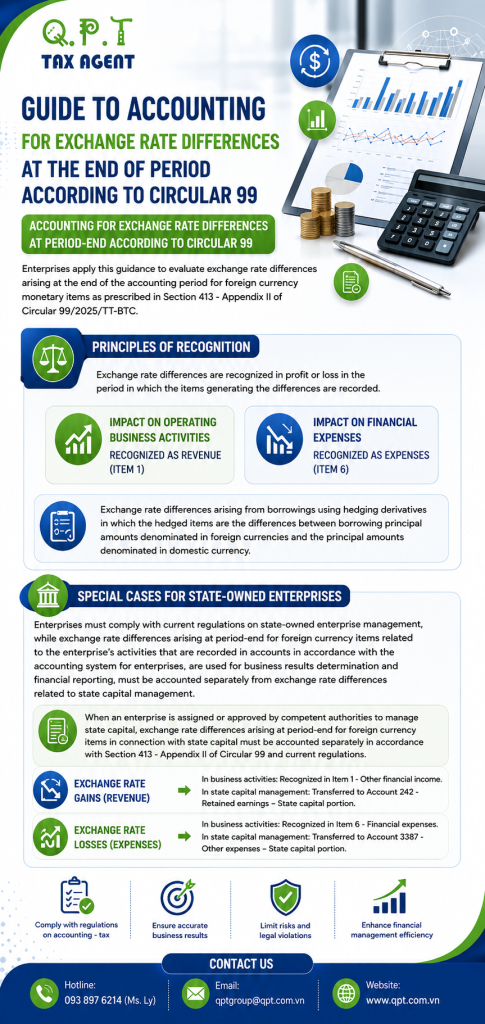
The principles for applying exchange rates when revaluing monetary items denominated in foreign currencies at the end of an accounting period are prescribed under Account 413, Part B, Appendix II of Circular No. 99/2025/TT-BTC, specifically as follows:
All foreign exchange rate differences arising from the year-end revaluation of monetary items denominated in foreign currencies must be recognized as financial income (if there is a gain) or financial expenses (if there is a loss) for the purpose of determining the business performance for the period.
Foreign exchange rate differences arising from the year-end revaluation of monetary items denominated in foreign currencies must be presented in the statement of income based on the net amount between the total foreign exchange gains and the total foreign exchange losses arising from the revaluation of monetary items denominated in foreign currencies.
– In cases where, under regulations applicable to state-owned enterprises, foreign exchange rate differences arising from the revaluation of monetary items denominated in foreign currencies during the pre-operating period of enterprises wholly owned by the State that undertake national key projects or works associated with macroeconomic stabilization, national security, or defense duties differ from the principles prescribed in this section (including the allocation period, method of allocating foreign exchange rate differences, etc.), such differences shall be accounted for in accordance with the regulations applicable to state-owned enterprises. Accordingly, if such enterprises are permitted to defer foreign exchange gains/losses arising from the revaluation of monetary items denominated in foreign currencies, the deferred gains/losses must be accumulated and recorded in Account 413 – Foreign Exchange Rate Differences and gradually allocated to financial income or financial expenses when the enterprise commences operations, according to the following principles:
- Accumulated foreign exchange losses during the pre-operating period shall be allocated directly from Account 413 – Foreign Exchange Rate Differences to financial expenses, without being transferred through Account 242 – Prepaid Expenses;
- Accumulated foreign exchange gains during the pre-operating period shall be allocated directly from Account 413 – Foreign Exchange Rate Differences to financial income, without being transferred through Account 3387 – Deferred Revenue.

What Are Foreign Exchange Rate Differences under Circular 99?
Pursuant to Part B, Appendix II of Circular No. 99/2025/TT-BTC, foreign exchange rate differences are defined as follows:
– Foreign exchange rate differences are differences arising from the actual exchange or conversion of the same amount of foreign currency into the accounting currency using different exchange rates.
– Foreign exchange rate differences mainly arise in the following cases:
+ Economic transactions arising during the period involving the purchase, sale, exchange, or settlement in foreign currencies;
+ Revaluation of monetary items denominated in foreign currencies at the end of the accounting period;
+ Translation of Financial Statements prepared in foreign currencies into Vietnamese Dong (VND).
What Does the Financial Statement System of an Enterprise Include under Circular 99?
Pursuant to Article 17 of Circular No. 99/2025/TT-BTC, the financial statement system of an enterprise is prescribed as follows:
The Financial Statement System of an Enterprise
1. The Financial Statement System includes:
– Statement of Financial Position;
– Statement of Income;
– Statement of Cash Flows;
– Notes to the Financial Statements;
2. Annual Financial Statements:
a) Annual Financial Statements for enterprises meeting the going concern assumption include:
– Statement of Financial Position – Form B 01-DN;
– Statement of Income – Form B 02-DN;
– Statement of Cash Flows – Form B 03-DN;
– Notes to the Financial Statements – Form B 09-DN;
…
Accordingly, the Financial Statement System includes:
– Statement of Financial Position;
– Statement of Income;
– Statement of Cash Flows;
– Notes to the Financial Statements.